
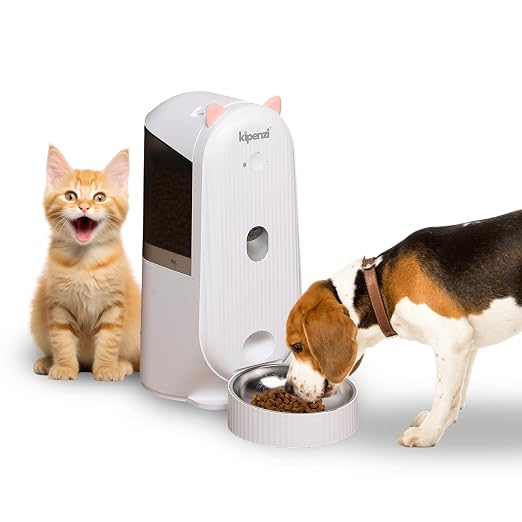
If you have a pet in India, you've probably wondered: "Should I get an automatic pet feeder?"
The idea is appealing — fill it once, and your cat or dog gets fed on schedule, even when you're at work or traveling. No more rushing home for feeding time. No more guilt about late dinners.
But automatic pet feeders are not as simple as they seem. Some work brilliantly. Others jam, dispense wrong portions, or break within months.
Here's what you need to know before buying one for your Indian pet.
Do You Actually Need an Automatic Pet Feeder?
Let's start with the straight question: do you need one?
You need one if:
- You work long hours and your pet's feeding time is inconsistent
- You travel frequently (even overnight trips)
- Your pet needs portion-controlled meals (overweight pets, medical diets)
- You have multiple pets and need to control who eats what
- You want to train your pet to eat at specific times
You don't need one if:
- You're home most of the day
- Someone in your household already feeds the pet on a schedule
- Your pet is a grazer (nibbles throughout the day)
- Your pet has special dietary needs that require fresh food (automatic feeders work best with dry kibble)
Types of Automatic Pet Feeders
1. Gravity Feeders (₹500-₹1,500)
The simplest type. Food drops down from a hopper as your pet eats from the bowl. No batteries, no programming, no timers.
Pros: Cheap, no power needed, always has food available Cons: No portion control, pet can overeat, doesn't work for weight management, pests can get into the food
Best for: Grazing cats that self-regulate their eating. Not suitable for dogs (they'll eat everything in the hopper).
2. Electronic Timed Feeders (₹2,000-₹5,000)
These dispense a set amount of food at programmed times. You set the schedule (e.g., 7 AM and 7 PM), and the feeder releases kibble automatically.
Pros: Portion control, scheduled feeding, works with app on some models Cons: Requires batteries or power, can jam with certain kibble sizes, needs regular cleaning
Best for: Working pet owners who want consistent feeding schedules.
3. Smart Wi-Fi Feeders (₹4,000-₹10,000)
These connect to your home Wi-Fi and let you control feeding from a smartphone app, even when you're not home. Some have cameras so you can watch your pet eat.
Pros: Remote feeding, app notifications, feeding history, camera monitoring Cons: Needs Wi-Fi, more expensive, app can be buggy, requires constant power
Best for: Frequent travelers and tech-savvy pet owners who want full control.
The Kibble Size Problem
This is the #1 issue nobody talks about. Automatic feeders are designed for standard round kibble. Indian pet food brands often have irregularly shaped kibble — especially the larger breed formulas.
Before buying, check:
- Your pet food kibble size and shape
- The feeder's recommended kibble size (usually 5-12mm diameter)
- Reviews mentioning "jamming" or "food getting stuck"
Pro tip: If your feeder jams, try mixing smaller kibble with your regular food. A 70-30 ratio often prevents jams.
Power and Connectivity Considerations for India
Power Outages
India has frequent power cuts. If your feeder runs only on AC power, it won't dispense food during an outage.
Solution: Buy a feeder that uses batteries as backup, or one that runs entirely on batteries. A feeder with 4 D-cell batteries typically lasts 6-12 months.
Wi-Fi Reliability
Smart feeders need a stable 2.4GHz Wi-Fi connection. If your router is far from where you'll place the feeder, it may disconnect and fail to dispense food.
Solution: Place the feeder near your router, or use a Wi-Fi extender. Test the connection before relying on it for your pet's meals.
Pest Protection
Indian homes have ants, cockroaches, and rodents. An open food hopper attracts pests.
Solution: Look for feeders with sealed hoppers. If yours doesn't seal, store the main food bag in an airtight container and refill the hopper weekly rather than monthly.
How to Transition Your Pet to an Automatic Feeder
Don't just switch and hope for the best. Pets are creatures of habit, and a new machine making noises and dispensing food can be terrifying.
Week 1: Place the feeder near your pet's regular feeding spot. Don't use it yet — just let them get used to its presence. Feed them normally.
Week 2: Start dispensing a small portion from the feeder while you're present. Let your pet associate the machine's sound with food. Hand-feed them a few kibbles from the feeder's bowl.
Week 3: Program one meal per day from the feeder (e.g., morning meal). Continue feeding the evening meal yourself. Stay nearby when the feeder dispenses.
Week 4: Transition to full automatic feeding. Monitor for a few days to ensure your pet is eating.
If your pet won't use the feeder: Try a different kibble, place treats in the bowl, or consult a vet. Some pets simply don't adapt to automatic feeders.
Budget Recommendations
Under ₹1,500
Gravity feeder — Only for grazing cats that self-regulate. Not suitable for dogs or portion-controlled feeding.
Under ₹3,000
HomerunX Automatic Pet Feeder — Timed dispenser, 4 meals per day, battery-powered. Good basic option for cats and small dogs.
Under ₹5,000
Wopet Automatic Feeder — Wi-Fi enabled, app control, 6L capacity, battery + power adapter. The sweet spot for most pet owners.
Under ₹10,000
Xiaomi Smart Pet Feeder — Premium build, app integration, precise portion control, camera option. Best for frequent travelers.
The Honest Verdict
An automatic pet feeder is a nice-to-have, not a need-to-have. If your life is busy enough that feeding schedules are inconsistent, it's genuinely helpful. If you're home most of the time, it's an unnecessary gadget.
If you do buy one, spend at least ₹3,000 for a timed electronic feeder. Gravity feeders and ultra-cheap models will frustrate you and potentially harm your pet's feeding routine.
And remember: no automatic feeder replaces the bond of feeding your pet by hand. Use the feeder for convenience, not as a replacement for your presence.
Related reading: considering a combo unit with camera? The feeder-camera comparison covers them


Top Picks at a Glance
| Feature | Kipenzi Smart WiFi Pet Feeder with Camera | PETLIBRO Automatic Cat Feeder 5G WiFi | PETKIT Automatic Cat & Dog Feeder with Camera |
|---|---|---|---|
| Capacity | 4L | 5L | 5L |
| App | Smart Life (iOS/Android) | PETLIBRO LITE | PETKIT |
| Price | ₹6,999 | ₹16,535 | ₹30,793 |
| Rating | ★ 4.4 | ★ 4.3 | ★ 4.3 |


