

Methodology: FluxPick has not personally used these products. Every result below is compiled from verified-purchase owner reports, manufacturer specifications, and price data checked against Amazon.in listings (mid-2026).
Standing desks are having a moment in India. Every WFH setup video on YouTube features one. Every productivity guru on Instagram swears by standing while working.
But here's the truth nobody tells you: a standing desk won't fix your back pain. In fact, if you use it wrong, it can make things worse.
A standing desk converter was used for four months. Here's what the evidence says — the good, the bad, and the "why didn't anyone tell me this before."
The Real Benefits (That Are Actually Proven)
1. You Move More
The biggest benefit of a standing desk isn't standing — it's the transitioning between sitting and standing. Each transition gets you moving, which is really good for your circulation, posture, and energy levels.
The notes describe naturally pacing, stretching, and shifting weight while standing — all of which are better than sitting frozen for 3 hours straight.
2. Afternoon Energy Dip Disappears
Owners describe hitting a wall every day at 3 PM. Eyes would glaze over, productivity would tank, and the coffee call became automatic. Since using a standing desk, that dip has largely disappeared. Standing forces your body to stay slightly more engaged, which keeps you alert.
3. It Forces Better Posture (If Set Up Correctly)
When you stand, you can't slouch into a chair and round your shoulders. Your spine is naturally more aligned — but only if your desk height is correct (more on this below).
The Problems Nobody Talks About
1. Your Feet Will Hurt
The first two weeks were brutal. Feet, calves, and lower back ached by the end of each day. Standing for extended periods is a physical activity — your body needs time to adapt.
The fix: Start with 30 minutes of standing per hour, not the full 8 hours. Build up gradually over 2-3 weeks.
2. Standing Still Is Just as Bad as Sitting
Here's the thing that productivity gurus miss: standing in one position for hours is not healthy. It compresses your spine, strains your feet, and can lead to varicose veins over time.
The goal isn't to stand all day. It's to alternate between sitting and standing. The ideal ratio is about 45 minutes sitting, 15 minutes standing — not the other way around.
3. You Need an Anti-Fatigue Mat
If you're standing on a hard floor (tile, marble, or concrete), you need a cushioned anti-fatigue mat. Without one, your feet, knees, and back will suffer. This is not optional — it's as essential as the desk itself.
A good anti-fatigue mat costs ₹800-₹1,500 on Amazon India. Don't skip this.
4. Cable Management Becomes Critical
When you raise and lower your desk, cables get pulled, tangled, and disconnected. Your monitor cable, keyboard cable, mouse cable, and charger all need enough slack to handle the height change.
The fix: Use cable management sleeves or under-desk cable trays. Give yourself 30cm of extra cable length for the standing position.
How to Set Up a Standing Desk Correctly
This is where most people go wrong. Here's the ergonomic setup checklist:
Desk Height
- Elbows at 90° — When typing, your forearms should be parallel to the floor
- Wrists straight — No bending up or down to reach the keyboard
- Shoulders relaxed — Not shrugged or raised
Monitor Height
- Top of screen at eye level — You should look slightly down (15-20°) to see the center of the screen
- Arm's length away — About 50-70cm from your eyes
Standing Position
- Feet shoulder-width apart — Don't lock your knees
- Weight evenly distributed — Don't lean on one leg
- Soft knees — A micro-bend prevents knee locking
Footwear
- Supportive shoes — Not barefoot, not slippers
- Or an anti-fatigue mat — If you prefer barefoot
Standing Desk Converter vs Full Standing Desk
You don't need to buy a ₹20,000 motorized standing desk. A standing desk converter sits on top of your existing desk and lets you raise your monitor and keyboard to standing height.
Converter advantages:
- Costs ₹3,000-₹6,000 (vs ₹15,000+ for a full desk)
- No assembly or furniture replacement needed
- Portable — move it between rooms or offices
Converter disadvantages:
- Takes up desk space (reduces your work area)
- Manual adjustment (gas spring, not motorized)
- Less stable at full height (some wobble)
For most Indian WFH setups, a converter is the smarter choice. You get 80% of the benefits at 25% of the cost.
The Honest Verdict After 4 Months
The standing desk hasn't transformed daily routine. It may not feel like a productivity god, and standing-desk back pain hasn't completely disappeared.
But users do feel better at the end of each day. They move more, stay more alert in the afternoon, and report fewer "stuck in chair" moments where three hours pass unnoticed.
If you're on the fence, start with a ₹3,000 converter. Try it for a month. If you use it consistently, upgrade. If it collects dust, you've only lost ₹3,000 — not ₹20,000.
Final tip: The 20-8-2 rule is the best guideline here: for every 30 minutes, sit for 20 minutes, stand for 8 minutes, and move for 2 minutes. That's the sweet spot.
Related: The guide to 7 best ergonomic office chairs under ₹5,000

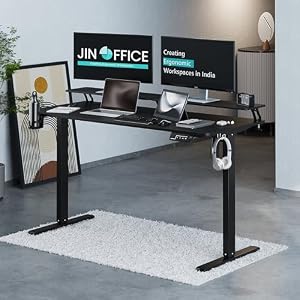


Top Picks at a Glance
| Feature | Green Soul Imperium Neo | Green Soul Zodiac Superb | Dyazo 360 Rotating Laptop Stand | JIN OFFICE Ascend | ARTIKEL Artidesk Eco |
|---|---|---|---|---|---|
| Motor | Dual-motor electric | — | — | Single-motor electric | Electric single motor |
| Load Capacity | 80kg | — | — | 70kg | 70kg |
| Height Range | 72-118cm | — | — | 71-117cm | 72-118cm |
| Price | ₹11,990 | ₹11,490 | ₹2,779 | ₹18,490 | ₹10,990 |
| Rating | ★ 4.4 | ★ 4.4 | ★ 4.4 | ★ 4.3 | ★ 4.3 |


